


 THE CHARTERING OF THE CITY OF PORT JERVIS
Who Blazed the Trail of History
Through the Heritage Walks
And Who Recalls Our Heritage
Through Interesting Historical Talks
He Uplifts the Past, Dusts It Off
And Makes It Come Alive
We Appreciate His Sense of Humor
And "Par Excellence"
As Our History, He Strives to Revive
As We Continue Together to
Promote Our Heritage, We Thank You Peter
Chairman
Port Jervis Area Heritage Commission
Heritage Days
July 26, 1997
The essence of history is remembering. Whether it be names, dates, events or trends, that is what historians try to preserve. In 1997 we celebrate the city's 90th birthday. It took a great deal of effort for civic leaders in 1907 to undertake the difficult political and legal process for Port Jervis to become a city. There was some criticism of their efforts, to be sure. But in the end, they accomplished their goal with great perseverance and community pride.
The purpose of this booklet is to allow readers to celebrate our city's birthday and reflect on what life was like in 1907. There are three sections: the first reviews the history of the chartering of the city and events leading up to July 26, 1907, when the enabling legislation was signed by the governor of the State of New York; the second section looks at the laws proposed in the charter and will surprise readers with how much power was vested in the hands of local government; and, finally, there is a thoughtful look at where the city has been and where it is going and how we might make it a better place to live and work.
Former Executive Director, Minisink Valley Historical Society
City Historian, City of Port Jervis
The village of Port Jervis was incorporated on May 11, 1853, having been carved out of the Town of Deerpark which was created in 1788. The village was granted a charter on March 30, 1866. That charter was amended for the first time in 1873 and again in 1890 when legislation was submitted to the state legislature to increase the size of the village to include the area called Carpenter's Point, now known as Tri-States.
The creation of the city of Port Jervis, New York, was a long and drawn out affair that began within a few years of the granting of the charter in 1866. Within ten years there was a growing opinion that the village should apply to become a city. Those efforts would culminate in the summer of 1907.
The process to get a charter for the city was slow and often trying for the major figures involved. The first effort to create a charter included members of the village's Committee on Legislation and Taxes, the Board of Trade and the City Charter Committee. In March 1902, a draft that was later to be called the Lybolt-Schofield charter, was submitted for public review. There was some criticism, not of the charter, but of the proposal to submit it to a vote by the general public when all of the provisions were not clear to the various groups that had a say in creating it.
By mid-March, a bill had been submitted to the legislature by New York State Assemblyman Louis Bedell and New York State Senator Louis Goodsell, but both believed the legislature would not pass it on such short notice as the term was near its end.
The issue sat idle until another committee of twenty was formed on May 10, 1905, to study the matter again. By February 1906, the committee was appointed to draft a new charter. Many of the community's most prominent citizens were involved in the effort including C. F. Van Inwegen, W.A. Parshall, D.M. McCathie, C.E. Cuddeback, S. H. Gariss, Galen Bennett, J.D. Swinton, W.S. Bevans, Charles Will, R. Ed Schofield, Frank Lybolt and W. H Nearpass. As one looks back on the whole process it was obvious this group was determined to get the job done and had the political clout to do so.
Between September 1905, and February 1906, the committee met regularly. Finally, on February 19, 1906, a series of questions was submitted to the board of trustees. Some of the questions were: What was to be the name of the city? What were the geographic definitions of the wards and how many were there to be? Other questions concerned salaries for the city's officials and tenure for policemen.
At their next meeting one decision with regard to the proposed boundary line was put off until more research could be done. But it was decided to name the new city Port Jervis. John Lyons, a resident and charter committee member, suggested that it be called Delaware after presenting the board with historical data to support his point.
Another decision made was whether to create a ward system or to have no wards. The latter idea was voted down and a ward system was approved, although the number of wards remained open to discussion. Meetings continued until November of 1906 when the Charter Committee had a final draft ready and solicited the council for funds to hire a stenographer to type a complete copy.
The final document was presented at a public meeting with all the remaining issues resolved including the number of wards and their divisions. The number of wards was of great partisan importance but was resolved because the plain, simple and natural divisions of the village were agreed upon. With that, the village's Board of Trustees voted to accept the charter and send it on to the legislature.
On April 20, 1907, Charles Van Inwegen and Fred R. Salmon delivered the proposed charter to New York State Senator John C.R. Taylor and New York Assemblyman Charles E. Marce so it could be presented to the whole legislature. Along with the charter went signed approvals by the Village Board of Trustees, the Executive Committee of the Board of Trade and the village committees of the Republican and Democratic parties.
The bill was submitted by Marce and it quickly passed to the second reading. At the same time, opposition to the proposed charter was being raised by Town of Deerpark residents and the village board immediately created a committee of four, led by the corporation counsel to continue to guide the bill through the legislature.
The Deerpark committee, which had already hired counsel, raised four specific issues that were the focus of their opposition. The committee's members were David Hammond, chairman; L.A. Johnson, secretary; David Bogart; Frank Patterson; Conrad Happ; C.J. Van Inwegen; J. Van Brown and Benjamin Swartwout who represented the districts of Huguenot, Sparrowbush and Cuddebackville. C. E. Cuddeback was their counsel.
In preparing a petition to the governor and legislature they raised the following four objections: The first was geographical. The new city would essentially be cut into two isolated districts, Huguenot and Cuddebackville on one side and Sparrowbush on the other. The Delaware and Neversink rivers, and the valleys they created would now be compromised and the town would be left with a mostly barren highland between the two distinct sections. A major part of this argument was that the town's assessment as it then stood was $2,490,950 and the newly configured situation would leave the town with assessments of only $503,113.
The second objection was that there were numerous crossings in Deerpark by long and expensive bridges. The expenses to construct, repair and maintain the bridges had been $20,000 in the previous three years and the maintenance would now fall solely on Deerpark which would have a considerably smaller population and valuation. And, the benefits would mainly go to Port Jervis residents.
A third objection related to the Deerpark's roads which had been authorized and constructed during a time when both Port Jervis and Deerpark maintained them. Highway law at the time stated that 15% of the cost of construction had to be paid by the town in which the highway laid. For Deerpark the estimated expenses would be $100,000. The proposed new town, with considerably less resources to pay for the highways, would be forced to have roads that residents from Port Jervis would be more likely to benefit from.
Finally, there was the issue of the poor. The legislature had recently required the town of Deerpark to create and pay for the office of Overseer of the Poor and his responsibilities included overseeing the poor in both town and village. However, the majority of the poor lived in Port Jervis and the burden of this salary, for a position whose duties would not be the same in a new town configuration, was inherently unfair.
Until the problems could be worked out the committee representing Deerpark requested the charter approval be delayed. Even from the perspective of nine decades, the committee's concerns were valid, although they did not apparently carry any major weight because the charter effort went forward. In all of the subsequent problems with the charter, the objections by Deerpark never seemed to play a role.
On May 16, 1907, the Port Jervis Amended Charter passed the New York State Senate and the following day it passed the New York State Assembly. From there it was to go to the governor's desk. While the sense in the community was a positive one, Governor Charles E. Hughes was known to oppose mandatory salary legislation which the city charter called for. The governor believed those matters belonged entirely in the hands of the local legislatures and not state representatives. When Binghamton and Middletown submitted similar charters, their charters were returned and changes were made and resubmitted.
When the bill came out of the committee, Hughes said he would veto it because of two provisions - one with regard to salaries and the second because of a section that concerned legal actions against the city with regard to defects in the streets. Senator Taylor immediately withdrew the charter and removed the two objectionable sections and then put it to another vote in the Senate. On June 18, it was taken over to the Assembly which had already adjourned and placed before the body on June 19. With the approval of the Assembly the charter went to the governor's desk for approval.
On July 26, 1907, shortly before 3 o'clock, after telegrams from W.H. Nearpass had been sent directly to the governor several days before encouraging him to sign the bill, the signature of the governor was attached to the law. Robert Fuller, the governor's secretary, telephoned the Port Jervis Union and confirmed the governor had signed the bill. On July 29, 1907, the first meeting of the Common Council of the City of Port Jervis was held and a process that had begun years before was finally complete.

Charles Evans Hughes was singularly the most important person involved in the chartering of Port Jervis. He was born in Glens Falls, New York, educated at Colgate and Brown universities and received his law degree from the Columbia Law School in 1884. His success as a reformer led him to run for governor in 1906 as a Republican. He was reelected in 1908. As governor he was known mainly for setting up public service commissions, curbing race track gambling and for reforms in state government.
He accepted a seat on the U.S. Supreme Court in 1910 and soon became one of its most distinguished members. After stepping down from the Supreme Court he ran against Woodrow Wilson and lost. In 1921, he became Secretary of State under President Warren Harding. He was named Chief Justice of the United States Supreme Court by President Herbert Hoover.
It was in this capacity that he was involved in one of the greatest constitutional battles of the century as he ruled against much of the New Deal of President Franklin Roosevelt provoking Roosevelt to attempt to stack the court with additional justices. He retired in 1941 and died in 1948, having achieved the reputation of being the greatest chief justice since John Marshall.
H.B. Swartwout, president; C. F Van Inwegen; Benjamin Ryall; George Post; J.J. Bippins; Thomas Cavanaugh; Emmet Garriss; James A. Orr; John J. Hawkins
C.F. Van Inwegen, chairman; R. Ed. Schofield, secretary; John Lyons; William Nearpass; F. R. Salmon; William Parshall; William Bevans; D. M. McCathie; A.T. Perry; S. H. Gariss; S.D. Boyce; Frank Lybolt; Galen Bennett; John Swinton; C.E. Cuddeback; Charles A. Will
H.B. Swartwout, mayor; W.N. Tuscano, alderman-at-large; C. F. Van Inwegen; Benjamin Ryall; J.J. Bippus; George A. Post; Thomas Cavanaugh; Emmett Garriss; John J. Hawkins; James A. Orr
On May 6, 1907, "An Act to Incorporate the City of Port Jervis" was submitted as amended and recommitted to the Senate's Committee on Affairs of Cities. And so began the final steps that led to the establishment of the City of Port Jervis. The charter was fairly typical of organizational documents of the period but it also reflects the era and things that were important to the community. It laid out in more than 160 pages the ward system, governing bodies, local laws, governing officials and their duties. Many of the laws are long gone, having been revised or updated as the years went by. A number of the items might raise an eyebrow or two for government leaders today and certainly shows how far we have come as a nation since then.
Compensation for local government officials in 1907 was very different than it is today. The mayor's salary was $300, the city clerk received $1,000 and the city treasurer $100. The superintendent received an annual salary of $1,200 while the city engineer's salary was subject to approval by the Common Council. Police officers were to receive a monthly salary of $50 while the chief was to receive $60 per month. The annual salary of the chief engineer of the fire department was $100. The assessor received $500 annually. None of the positions then came with benefits, according to the charter.
The mayor was considered the chief executive officer of the city and it was generally "his duty to maintain the peace, good order and prosperity of the city." Most of the duties outlined were what one would have expected but he also had some extraordinary powers. He was, for example, "empowered to enter any house or building in which he had cause to suspect was a gambling house, or to be inhabited by persons of ill-fame, or to which persons of dissolute, idle or disorderly character resort, and disperse the same, or arrest such persons and hold them until they can be dealt with before some proper magistrate."
Longtime residents will remember the term "councilman" is a relatively new one. For several generations the representatives of the wards were called alderman. The aldermen's duties were outlined in the charter and were, for the most part, what one would have expected. However, aldermen could also arrest or cause the arrest of people who broke local or state laws in the city. One interesting responsibility concerns fence viewing.
"The aldermen of each ward shall be fence viewers and shall possess all the powers and authority in respect to division fences or walls in their ward which are given by law to fence viewers of towns with respect to division fences, and shall be entitled to receive the same fees as fence viewers of towns."
The Common Council had strong enforcement powers that have been reduced considerably over nine decades. Other regulatory agencies, county, state and federal, have increasingly taken over those responsibilities.
The council was to:
"prevent vice and
immorality, to preserve peace and good order, to prevent and
quell riots and disorderly assemblages."
"to suppress disorderly houses, houses of ill fame, gambling, gaming tables, and all instruments and devices employed in gaming, to regulate or restrain pool and billiard playing by minors in public places and the playing of the games of chance by minors, also to restrain minors from being in public places at night within specified hours when not attended by adult persons;"
"to prohibit and punish the sale of liquor, wine, ale and beer to minors; to restrain and provide punishment of vagrants, mendicants, persons without visible means of support, keepers of houses of ill fame, common prostitutes, lewd and disorderly persons, drunkenness and disorderly or immoral conduct in said city . . .and to regulate or restrain all occupations and business noxious to public comfort."
"to prohibit all exhibitions of any natural or artificial curiosities, circuses, theatrical and other shows or exhibitions or performances, whether free or for money, within the bounds of the city or if the council deem advisable to license the same."
"to prohibit persons from collecting or standing upon or occupying the streets, alleys, sidewalks, bridges, hallways, entrances, passages or stairways in said city, to require persons driving horses with sleighs or cutters to carry ringing bells either upon horses, sleighs or cutters; to regulate the width of tires of all wheeled vehicles and generally to preserve the streets and public places of the city free from all obstructions."
"to direct the location of all houses for storing of gunpowder and other combustible and explosive substances, and to regulate the keeping, selling, and use of candles and lights in barns, stables and outbuildings."
"to prevent horse racing, immoderate driving in the streets. . . to prohibit and punish the flying of kites and every other game, practice or amusement in the public streets or elsewhere having a tendency to frighten teams or horses, or to injure or annoy persons passing in and along the highways of the city or to endanger property."
"to regulate coasting and bicycle riding in the city."
"to restrain the running at large of cattle, horses, swine, sheep, goats and geese and other domestic animals."
"to prevent or regulate the ringing or tolling of bells, blowing of whistles and horns or the crying of goods or wares, the firing of cannon, guns and other firearms, and the sale and use of firecrackers, rockets, squibs, powder and other explosive compounds and the making of any improper noise which may tend to disturb the peace of the city."
"keep in repair the public fountains of the city."
"to regulate the speed of running trains of cars in the compactly inhabited portions of the city and for one mile from the depot of said city and to regulate runners, stage drivers and others in soliciting passengers and others to travel or ride in any stage or omnibus or to to any hotel or elsewhere."
"to compel direct and regulate the planting of shade trees and ornamental trees along the streets and sidewalks of said city and to prevent injury and destruction of such trees."
"to regulate and restrain the emission of smoke, soot ashes and offensive and deleterious gases or odors from the chimneys and smokestacks of buildings with the city and from the smokestacks of locomotives."
The police department was to have its chief appointed once a year and the force was not to exceed 8 patrolmen. Compensation was not to exceed $3 per day and extra policemen could be hired if the council authorized the expenditure. Policemen were required to be a U.S. citizen and had to be able to read and write in English. At their time of employment they could not be engaged in any form in the liquor business.
A Commissioner of Charities was required under the city charter and his job was the equivalent of the overseer of the poor that had been authorized for the towns. This job and responsibility would ultimately end with the home relief programs of the 1930s that were and are administered by the county. More recently, advocates have pushed for the idea of returning these responsibilities to local government.
The commissioner possessed all the power and authority: "to the support and relief of indigent persons, the binding out of children, the care of habitual drunkards, the support of bastards and proceedings to charge the fathers and mothers of such bastards. He was required to visit the poor of the city at their homes and determine what their needs might be. At that time the city was responsible for the costs with regard to the poor."
With the signing of this act the Village of Port Jervis was dissolved and the City of Port Jervis created. The new entity was required to assume all of the liabilities and obligations of the village. As for the town of Deerpark, the entity would continue to include all the property that had not been incorporated into the city. Any debts that had been acquired by both entities were to be evaluated and then divided proportionately after that. The village's officials were to remain in position until the newly elected officials were to take their offices after elections.
On July 26, 1997, the city celebrated its 90th birthday. 1997 also marks the 150th anniversary of the arrival of the Erie Railroad in Port Jervis, which forever changed that canal village into a major railroad center. For this river community it was a crowning moment on that hot, muggy afternoon because it culminated a four-decade long development process that had brought Port Jervis from a settlement on the western frontier to a sleepy village on the canal and then finally to a major railroad and industrial center. Many felt it was only right that this regional center should be proclaimed a city.
Port Jervis, after all, had been the first in Orange County to have electricity, one of only three municipalities in the county to have a trolley, was home to the second oldest historical society in the county and most recently, the only town in Orange County to have a Carnegie Library, a distinction that still remains in 1997. Its Civil War monument was considered to be one of the finest in all of the southeastern part of New York and the nickname for the city was the "Queen of Shawangunks."
As the years went by the city continued to prosper until the Great Depression of the 1930s. During the war the economy rallied again but in the 1950s a long decline began as railroads around the country began to consolidate operations with the introduction of the diesel locomotive. Most people today will remember that period with nostalgia, but the city's economic fortunes were already in decline by this time. By the 1960s the railroad's major presence was ended and this gritty old railroad center struggled with what its future course should be.
After long and heated debates by the local citizenry the city's leaders chose the Urban Renewal process as the best way to try and rescue the city. More than 50 buildings were demolished, many of which were derelicts. But many were the most beautiful in the city and represented its very spirit and soul. The promise of Urban Renewal - the revitalization and rebuilding of the downtown was never realized - although many projects were carried out under its auspices.
The economic decline of the city has continued to bedevil subsequent administrations, both Democratic and Republican. While each party has taken turns blaming the other, the problems the city faces are much the same as in other cities large and small across America. Many of the main industries that once were the backbone of the Port Jervis economy moved to southern states in an effort to reduce labor costs. Others simply went out of business as times changed. Some, mainly the local retail establishments, died long and slow deaths as malls sprang up.
As personal incomes and the potential for obtaining good jobs declined many of the best and brightest young people left the area and expectations intellectually, economically and culturally declined as prospects became dimmer. Where we as a community had once aspired to have a Carnegie library - a major accomplishment given that only 1,600 were built in the entire country - now we as a community struggle to survive and keep our downtown from completely emptying out. We tend to complain about a great deal - the dirty streets, crime, empty store fronts and so on. And all of those are valid concerns.
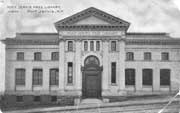
In the final analysis the community today as a whole does not have the lofty goals of the generation that created the City of Port Jervis. We do not speak of our community with the pride that an earlier generation did. We do not see ourselves as an up and coming urban center as local boosters did in earlier years nor do we exude optimism given our natural location that is so advantageous. As an example, here is a typical promotional piece from the local business community published in The Semi-Weekly Gazette, September 15, 1905:
- Advantage of Location
- Healthfulness of its climate
- Steam and Electric Railroad Accommodations
- Good stores and public spirited tradesmen
- Pure water and plenty of it
- Gas and Electric lights
- Sound financial institutions
- Splendidly equipped fire department
- Tone of society healthy
- There are no epidemics
- Economical local government
- Social advantages are numerous
- Adequate educational facilities
- Enterprise of most of its inhabitants
- Good hotel and boarding accommodations
Many of the fundamental advantages that created this great city remain in place. The city is and remains at the region's crossroads - it is still crisscrossed by the area's major highways. Local architect Bernard Kozykowski likes to say that "the city's greatest asset is that is in the way." After three centuries. It is still surrounded by two beautiful river valleys and vast tracts of parkland and forest land. It sits in the middle of two National Park Service recreational facilities and it borders the last undammed river east of the Mississippi, the wild and scenic Delaware.
The nickname "Queen of the Shawangunks" is as apt today as it was in the 1920s. The city owns the recently reopened Elks-Brox Park, a beautiful tract of land that offers one of the finest vistas in the region. It is still easily accessible to the metropolitan areas. And, for those who come from large cities it still has what local attorney William Bavoso describes as "quiet and unassuming charm."
There have been some remarkable successes in recent years to turn the city around. The Port Jervis Erie Depot, the last remnant of the railroad's past was rescued and saved through the efforts of the Depot Preservation Society, the Minisink Valley Historical Society and the Port Jervis Development Corporation and then two local developers Lenny Miglianico and Dick McKeeby. The effect of that project has been contagious in that a number of other buildings downtown have been renovated or are under renovation, some using the same color scheme as the depot. The original leaders of the depot effort predicted that the long-term effect would be a positive one and while it has taken longer than anyone imagined, that idea has been borne out.
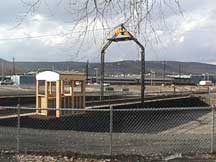
Another project that is an outgrowth of the depot project, the Erie Turntable renovations, was undertaken by the City of Port Jervis, Depot Preservation Society, the Minisink Valley Historical Society and countless volunteers who donated hundreds of hours of time. The restoration of the largest operating turntable in the United States led to a series of excursion trips in the fall of 1996 and spring of 1997. This project holds enormous potential for the city and its economy.
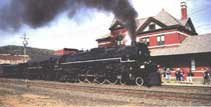
Last fall it was estimated that 60,000 people came to Port Jervis for steam excursions. About 400,000 passed through on their way to the Upper Delaware Scenic and Recreational River. Thousands floated by in rafts. While the effects of those visitor's trips to and through the city will not be readily apparent or even measurable in the immediate future, some of those same people will retire here, buy merchandise locally, use a local attorney and real estate agent. They will also become taxpayers and members of historical societies.
In earlier times a local business community quickly developed and then capitalized on such opportunities. First, it was the Old Mine Road as inns were opened along its route. When the canal came to Port Jervis, blacksmith shops, inns, mills and general stores opened along its route to take advantage of the passing traffic and the new residents that it brought.
When the railroad arrived, industries popped up throughout the city - taking advantage of railroad sidings and the access to great markets to the east and midwest. Liveries, hotels, opera houses all blossomed to take advantage of the passenger traffic and those who were moving here. At one time there were more than 80 industries here.
As we look to the future we need to look at our past. We need to do the same thing today that the leaders and businessmen did in earlier eras - capitalize on the hundreds of thousands of people who were passing through. If we do not, and that is a choice we can make, they are still going to pass through because we remain at the crossroads, "still in the way," whether we want to be or not. If we fail to act, the decline that began with the introduction of the diesels will continue.
Heritage tourism is not the whole answer to the city's deep problems to be sure, but it is a part of the answer. With the promotion of heritage tourism, the quality of life will improve and that in turn will hopefully bring other light industries and development here if other regions and towns around the country are a good indication. Perhaps the negative feelings that so many people have will begin to wane as the economy blossoms again. And with that, hopefully will come relief from the depletion of both spiritual and financial resources that has been overtaking the city in the last several decades.
In spite of the anti-government sentiment that is sweeping the nation this writer would argue we need a collaborative effort to restore our community to greatness. We need to work together with the private sector including local corporations and retail businesses; government, on a local and county level, and the citizenry of the community all taking an active role. This is not a job for private enterprise or for government alone to deal with as is often said. Nor was it in previous times.
Collaborative efforts have often worked in the city's more distant past and also in more recent times. In fact, they have often brought together segments of the population who might not necessarily have worked together. Examples of the successful nature of such recent projects include the efforts of the Port Jervis Development Corporation, the Community Development Agency, the Dazzle on the Delaware River Festival, the Fall Foliage Festival and the depot and turntable projects.
As we look back on the 90th anniversary of the creation of the city we need to have lofty goals again, as our forefathers did in the early years of this century. There are problems in the city to be sure, there always have been and always will be, but we need to look beyond them and small town politics, and look at the broader canvas. We should aspire to greatness again - we should capitalize on our geographic location - and use the wealth, both spiritual and financial, created by that to make our city vibrant again.
This booklet is the result of the efforts of a number of groups, businesses and individuals. The Minisink Valley Historical Society provided for the use of its large collection of photographs and historical materials. Janis Osborne edited the booklet and provided the author with research assistance. Susan Howard, Stanley Cohen and the production department of TheGazette donated layout and photograph work required to make the book possible. Jim Williams, "the Ladies of the Club" and Williams Printing, of Matamoras, Pennsylvania donated printing, collation and stapling of the booklet.
The following individuals and organizations provided research materials, helped in researching various archives to obtain materials used in this booklet or offered general assistance: Richard Tarbell, Miral Haubner, Irene Cosh, Bernard Kozykowski, William Bavoso, the Port Jervis Free Library and Krauss Photo
The author also would like to note the efforts of many area residents who over the years have provided some of the material incorporated into this booklet and also those who have helped preserve the city's history. To all of these people, we offer our sincere thanks for making this publication possible.